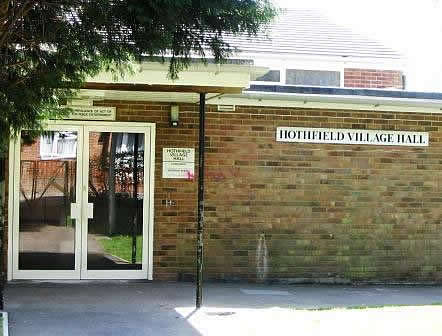
The walk begins at Hothfield village hall (1). The land on which it stands was given to the village by Sir
Reginald Rootes (of Rootes Group cars). The hall was
officially opened by Sir Reginald in 1975 and continues
to serve the local community to this day.
Turn right into Park Drive and continue into Waterfall Road. Set in countryside of woods, fields and parkland,
Hothfield is surrounded by interesting houses and
farms including Home Farm on your left (2), which
would once have supplied produce for the Lord of the
Manor. Originally called Park Farm, Home Farm was
built in 1809 using bricks from the old Rectory faced
with mathematical tiles, which were designed to look
like brickwork. This was felt to be the best method for
keeping water off a vertical surface (see sample by gate).
In 1803 roofing tiles as well as bricks had to bear a tax
but the mathematical tile – a mixture of the two – did not.
Outer Gate Lodge, its central window bay curved like
the ‘eyebrow’ of a thatched roof, was built in 1809 along
with the farm; the Lodge opposite was built in 1913.
Seventy yards further on, to the left, is a track called
Grafty Lane, the entrance to which, in the 1950s, was
known as Lovers Gate. It led to Grafty Farm, situated by
a stream, and continued as Yonsea Lane to the main road.
These lanes were part of the old Maidstone to Ashford
road, which went past the Woolpack inn, across the
common, to a sand pit behind the present bus stop, then
on to Home Farm and beyond. An alternative route was
made c.1797 and in 1810 it was altered again to form the
pre-Rail Link A20, with a Toll House at Potters Corner.
During the Second World War scores of barrel-roofed
Nissen huts were built in the village and on the common
for use by the troops. When the war was over, the huts
were used to house people during the post-war housing
shortage. Ashford MP Bill Deedes campaigned for them
to be demolished as a health hazard and eventually, in
1955, the occupants were re-housed. In the field after the spinney on the right, six huts, known as Home Farm Camp, were built for use during the war, and were still
occupied in 1949.
Hothfield’s
picturesque waterfall
(3), taken in 1901, with
its rustic footbridge and,
just behind it, the sluice
gate. Photo courtesy: www.francisfrith.com |
You will shortly come to a waterfall on your left
(3). This was made in 1851 by damming the stream(s)
from the North Downs, which also created the fishpond,
sometimes used as a boating lake. The road was still
forded at this time with foot travellers crossing a bridge
over the waterfall. In 1864 the road was made up, the
river was bridged and the water was piped under it.
The lake used to freeze over in winters past and skating
parties were a familiar sight in the 1920s, when the
banks would be lined with spectators. To the right of the
waterfall is a pumping station, comprising an overshot
waterwheel fed by a pipe from the raised level of the
lake. This drove a twin-piston pump. The apparently
clean water appears to come by pipe from springs higher
up in the field opposite and is pumped back around the
bridge. The ‘Manor’, a mansion house called Hothfield
Place, and its kitchen gardens were amply supplied with
water by this means.
Echoes of Second World War activity are to be found
all around Hothfield. At the T-junction you will see a Pill
Box ahead, an example of anti-invasion defences (4).
(For a short cut, follow the Greensand Way
to the right behind the Pill Box and rejoin the walk at X.)
Turn right and continue along the road past West Lodge,
at the estate boundary to Godinton House, a striking
Jacobean manor with distinctive gables, set in parkland,
which is well worth a visit.
Opposite West Lodge, 100 yards across the field, a
Hurricane plane crashed on 29 October 1940, taking the
top off a redwood tree. The pilot, Sgt Black, had baled
out but unfortunately later died in hospital. The remains
of the plane were dug out in 1988-90.
Further on, you will come to Swinford Manor (5) on your left, now a school but originally an Elizabethan
yeoman’s house and one of the oldest in the Parish. The
name Swinford may derive from ‘swineford’, suggesting that there was once a ford across the River Stour so that
pigs could cross. |
A Wealden hall house by design, the wings of Swinford Manor were added later as was the
19th-century porch with its shaped Dutch gable, which
contains a cartouche of the Toke family, who lived at
Godinton (Swinford was once the estate’s Dower House).
Alfred Austin, Poet Laureate from 1896 to 1913, rented
the house from the Toke family and several of his works
refer to this place, particularly ‘The Garden that I Love’
(1894). In the grounds is Alfred’s Oak, reputedly the site
of the first Parliament in England. At the electricity sub station, take the footpath to
your right. This leads through a field, over the Ashford
Flood Alleviation scheme bund and across a stream via
a narrow footbridge. Hothfield is the proud possessor of
what was once the world’s largest hydro-brake. Look right
for a good view of the charred silhouette of Sgt Black’s
redwood tree and behind you for a view of Swinford
Manor. Continue until the footpath meets the Greensand Way; then turn left towards the 13th-century Church of
St Margaret. The Greensand Way is so-called because
of the green-coloured mineral, glauconite, that is found
throughout the area.
About 100 yards to your left, in the direction of the
new dam, is Mansion Copse where you can still see the
remains of wartime slit trenches. Just beyond the copse
are vestiges of a carriage drive wall (6), all that remains
of Hothfield Place. It was built in 1778-80, probably
by the architect Samuel Wyatt, for Sackville Tufton, 8th
Earl of Thanet. The Earl married Mary Sackville, sister
of John, 3rd Duke of Dorset. Sackville and Dorset were
famous patrons of Kent cricket. In due course, the Dorset
family seat, Knole in Sevenoaks, passed to the Duke’s
daughter Elizabeth, who married George West, 5th Earl
De La Warr. An inability to produce heirs down the male
line meant that in 1845, the dukedom became extinct and
the estates passed through Elizabeth to the West family
(who assumed the additional surname of Sackville by
Royal licence). The poet Vita Sackville-West was the
daughter of the 3rd Baron Sackville. Prevented from
inheriting Knole by laws of primogeniture, she acquired
Sissinghurst Castle with her husband Harold Nicolson
and created the beautiful gardens there. |
Hothfield Place in
1901, with its sweeping
carriage drive, remnants
of which are all that
remains of this once
impressive mansion
house (6) Photo courtesy: www.francisfrith.com |
In addition to the mansion house, there were farm buildings and stables. In the 1800s the 350-acre estate
was almost self-sufficient; it also provided the village
with its own train station and gas supply as well as a
source of employment. Years later, Capt. the Hon. J.S.R.
Tufton planted an oak tree, known as the Tufton Oak (7),
about 50 yards from the front drive of Hothfield Place,
in the direction of the lake, to mark his safe return from
South Africa on 11 September 1902 (presumably from the
Second Boer War). It can be seen near the water trough,
and is still growing.
But by 1954 Hothfield Place had fallen into a state
of disrepair following its occupation by the army in the
Second World War and bomb damage. Its then owner, Sir Reginald Rootes, had the original building demolished and a new red brick house built (this was Polla House,
now the Hothfield Manor Centre for Acquired Brain
Injury) but a number of the farm buildings still exist, albeit in redeveloped form.
Set high to the south of the village, the Church (8) has had a dramatic history. It was struck by lightning in
1598 and a large part of it burned to the ground. It was
rebuilt in 1603 by Sir John Tufton and remained intact
until the Battle of Britain in 1944. Eight ‘doodlebugs’ fell
within the boundary of Hothfield and one hit a lime tree
on the corner of the road by the churchyard. It exploded,
damaging the roof and blowing out many of the stained glass
windows. Since restored, this little Church, built
largely of Kentish ragstone with a shingle spire, contains
a gem – the splendid 17th-century marble Tufton tomb – which can be seen through the north windows.
Follow the path past the west door of the Church
and see if you can find two interesting headstones: one
to James Gaunt, shepherd, who died in 1868, which is
carved with a shepherd’s crook and shears, and another
to James Waters, gardener, who died in 1864, which is
carved with a spade, rake, hoe and two groups of flowers.
As you walk down Church Lane towards the village
you will pass what were once the walled kitchen gardens
to Hothfield Place on your left and the gardener’s
house (now Garden House) to your right. Thanet House
(originally called ‘Little Hothfield’), opposite the
entrance to Church Lane, which has a huge monkey-puzzle tree in the grounds. was built in 1850 for Sir
Robert Hoare, then land agent to Hothfield Place.
Turn right into The Street, following the old estate wall. The parkland to your right is called Ice House Field
(9), as this is where ice was stored in a deep brick-lined
pit for use at the mansion. The Ice House was levelled in
the 1960s. The field was also the site of what was known
as the Gas House. Dismantled before the war, and used
to house chickens in the 1950s, it too was levelled in the
1960s but if you look over the estate wall you can still see
the circular gasholder base.
The old Rectory once stood adjacent to Ice House Field, probably not far from the village hall. Thirty
lime trees formed an avenue from the Church to the
Rectory, known as Rector’s Walk, of which fourteen were
still standing in 1900, although the Rectory itself was
demolished in 1808-09.
Many houses in The Street suffered war damage: Thanet House had all its windows blown out and No.
5, High House, was barely habitable. If you look up at
the eaves of High House (10) you will see a painted
inscription, which begins ‘Dr Coetlogon’s Genuine True
and Original Tincture and other Medicines by the King’s
Patents’. And inscribed over the doorway ‘Drugs, Oyls,
Glass and Earthen Wares 1762’. Dr Coetlogon was a Huguenot, who sold the rights in his tincture to a Mr Haffenden of Bethersden, who sold it as Haffenden’s
Tincture, the name by which it was known well into the
18th century.
Further down The Street you will come to No. 24, the
Tufton Bailiffehouse (11), which was once the Thanet
Arms and before that the King’s Head. Dating from the
17th century or earlier, this is where the Ashford Valley
Hunt used to meet and the Bolebrook beagles are still
kennelled in Hothfield. The houses opposite date from the
mid-1950s, replacements for the Nissen huts. The street names – Tufton Street, Coach Drive, Sackville Close – all reflect local interest.
As you approach the T-junction with School Road
(right) and West Street (left), you will see in front of
you the Victorian village school (12), now a children’s
centre, which was built in 1874 by Sir Henry Tufton, 1st
Baron Hothfield. In 1900 there were 166 children; the
school was closed that year due to a measles epidemic, in 1902 for chicken pox and in 1906 for scarlet fever.
The long summer breaks were filled with hop-picking. Turn left into West Street. This is where the school was originally situated. As you pass Nos 1-9 you can still see the inscription over the porch of the centre house: ‘These schools were erected by the Earl of Thanet in 1834’. This is where the schoolmaster lived and where the children
were taught. No. 1 West Street was later a butcher’s shop.
Next pick up the footpath behind the school that leads
to Hothfield Heathlands (formerly known as Hothfield
common), one of England’s last remaining ancient heathlands and Kent’s last surviving valley bog (13). It
is designated as a Site of Special Scientific Interest and
a local nature reserve due to its acid grassland, bogs,
mires and wooded heath. There is a nature trail and
many footpaths across its 100 acres. Take the Giants and
Bogs Walk across two boardwalks. The common was
probably an ancient grazing ground during the Bronze Age. Earliest records suggest that the name ‘Hothfield’
is of Saxon origin and comes from ‘heath’, meaning
a place where wood was once felled. Following the
Roman invasion, the common became the property of
the Lord of the Manor. For some 1000 years, apart from
stock grazing, the common would also have provided
wood, turf and peat for fuel, heather faggots for road
foundations, bog moss for wound dressings and bracken
for stock bedding.
It is notable for its rich and varied plant life, insects,
birds and reptiles. Look out for heather, cross-leaved
heath, dwarf and common gorse, spotted orchids, bog
asphodel and round-leaved sundew; dragonflies, such as
the keeled skimmer; and the viviparous lizard and grass
snake. The Kent Wildlife Trust manages this remarkable
landscape, restoring favourable habitats for increased
biodiversity. A herd of Highland cattle and Konik ponies
also now graze the site from time to time, to encourage
heath bog species to re-colonise.
With the advent of the Second World War, the
common, together with Hothfield Hospital (the former
workhouse), which was at the north-west corner, was requisitioned as an army training ground. If you pick up
the Fen and Dragonfly Walk and head towards a third
boardwalk, you will come to a wide trench, still known as
the ‘tank trap’, which was probably used to camouflage
Bren Gun carriers – one of a number of visible wartime
reminders, which also include First World War practice
trenches. Turn around and walk up the hill for the best
views of the surrounding Kent countryside.
Bordering the common on its east side is Cade Road,
possibly a reference to the legendary Jack Cade. In 1450
increased taxes imposed by Henry VI and corrupt local
landowners sowed the seeds of rebellion and the men of
Kent and Sussex, led by Jack Cade, marched on London.
They defeated the Royalist forces near Sevenoaks, only
just failing to take the Tower of London. Cade fled to the
Weald, the King having demanded his arrest, but he was
apprehended by Alexander Iden, Sheriff of Kent, and died
en route to London.
Retrace your steps to the school house and cross
School Road into The Street. Turn left to return to the
village hall.

The Sackville-Tufton coat of arms, which resides at Home Farm.
It is dated 1629, the year in which John Tufton, 2nd Earl of Thanet,
married Margaret
Sackville. Photo: courtesy Rixpix.

Map © Crown Copyright, Licence No 43513U
Map legend: (Click map for a larger version)
1 Village hall
2 Home Farm and lodges
3 Waterfall and pumping station
4 Second World War pill box
5 Swinford Manor
6 Remains of Hothfield Place |
7 The Tufton Oak
8 St Margaret’s Church
9 Ice House Field
10 High House
11 Tufton Bailiffehouse
12 Village school
13 Hothfield Heathland |
If there are points of interest that you feel might be added to the walk, we would like to hear from you.
Please email
the Hothfield History Society at hothfieldmemories@hotmail.com |
|